Love and Justice
Definition and analysis
Ikechukwu Nwanze
4/7/202610 min read
What is Love?
The concept of love varies across people. This variation arises because each individual or group forms their understanding of love through everyday interactions, personal standpoints, observations, and society’s interpretations. Depending on who defines it, common phrases found in many definitions include:
“Love is an emotional feeling…”
“Love is subjective, personal, and partial…”
“Love is an enduring attachment…”
“Love can be familial, romantic, or platonic…”
“Love focuses on individuals rather than systems…”
“Love allows for the bending of rules…”
“Love is forgiving, sacrificial, merciful, and seeks exceptions…”
The true conception of Love
Based on the varied definitions of the concept of love presented above, it is clear that no single, uniform definition exists. This lack of uniformity means that people apply the concept of love differently in different contexts and places. What is regarded and accepted as love in one setting may be rejected in another. These differences will ultimately lead to confusion, chaos, and collapse unless a clear explanation of the concept is provided. A clarified definition of love is essential for forming the building blocks of a spiritual understanding; without it, misunderstanding will hinder spiritual progress. For an accurate explanation of the concept of love, consider the following passage from The Grail Message:
"Genuine love will not consider what is pleasing and agreeable to the other, what brings him joy, but will only consider what will benefit him, regardless of whether it affords him pleasure or not! That is genuine love and service." — In The Light of Truth: The Grail Message, Abdruschin
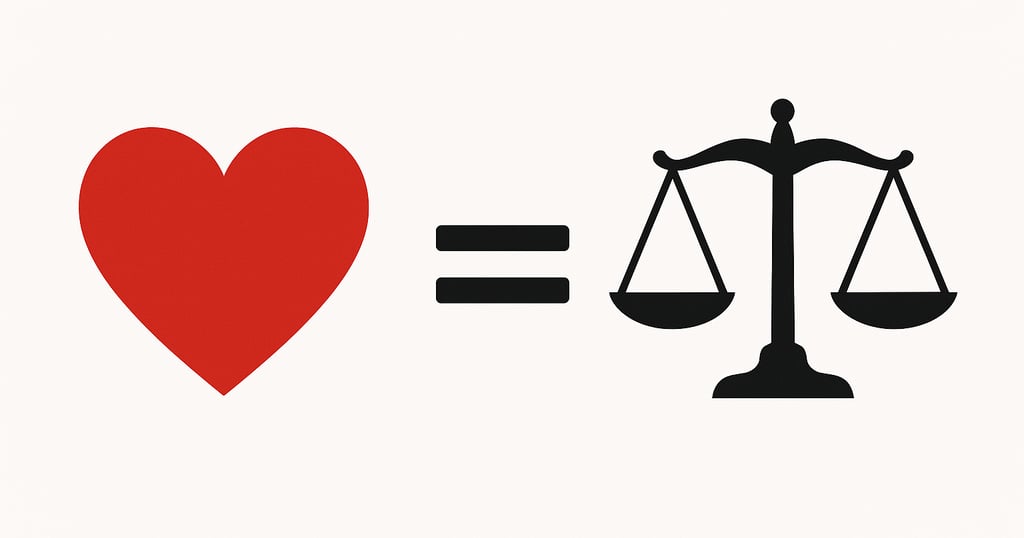
We can deduce from the above definition that genuine love considers only what will benefit the human spirit, regardless of whether it brings pleasure. For any consideration to occur, there must first be a preceding action. That action is initiated by creatures in Creation, of which the human spirit is one. Every second the human spirit exercises free will in making decisions, and those decisions have consequences that are either upbuilding or destructive. In weighing these consequences, genuine love either encourages or discourages; this encouraging or discouraging action is also called justice. When it encourages, it is experienced as love; when it discourages, it is experienced as justice. In reality, these are the same power whose differing effects make them appear distinct. This singular power, whose effects vary according to how creatures in Creation use it, is the Neutral Creative Power of the Creator. That power is also referred to as Divine Power, Living Power, Divine Love, Divine Justice, the Laws of Nature, the Will of The Father, Natural Laws, Eternal Laws, The Will of The Almighty Creator, the Primordial Laws of Creation, and Divine Will.
From the deductions above, we can arrive at a clearer understanding of this Bible verse:
“Do not think that I have come to abolish the Law or the Prophets; I have not come to abolish them but to fulfill them.” — Matthew 5:17
From the verse above, it can be understood that the Law and the Prophets are fully aligned with the mission of Christ. He came not to abolish them but to fulfil them. This fulfilment means that He came to execute and actualize the Law, making it real and bringing it to its complete expression. It means He brought the Law to its full effect, performing and obeying it perfectly.
The Old Testament can be understood primarily as a book of justice, while the New Testament can be understood primarily as a book of love. These two emphases complement and unite one another, so that a correct conception of love and justice reveals them to be aspects of the same moral order. Love wishes what is best for the other, as simple and as straight forward as this definition of love is, one can equally say that Justice wishes what is best for the other.
Correction, which is another name for justice, is therefore a form of love seen from a different angle: one cannot sincerely want the best for someone and ignore them when they go astray. True love will speak up and or act so the loved one understands the consequences of their actions; the loved one retains the free will to accept or reject that correction.
Christ taught with love, explaining why certain actions bring disharmony among humankind, and he affirmed that he came not to abolish the Law or the Prophets but to fulfill them. A similar principle - at a level accessible to physical understanding - operates in earthly judicial and educational systems. Both the judicial/legal (rehabilitation) system and the educational system are, at their core, self‑correcting mechanisms designed to improve individuals and society over time. They operate in different domains - law and learning - but share a common purpose: to identify shortcomings, address them, and create conditions for growth and better outcomes. Together, they form a mutually reinforcing cycle of societal progress. In each system, progression is conditional upon demonstrated change or mastery, and the cycle repeats until the required standard is met.
The Laws of Nature or Natural Laws
"To be natural, however, means to ascend, to strive upwards, following the attraction of the Living Power. For where there is naturalness everything strives upwards only, just as every blade of grass, every flower and every tree does." — In The Light of Truth: The Grail Message, Abdruschin
The Natural Laws or the Laws of Nature, which are effects of the Divine Power of the Creator - the Will of The Father or the Will of The Almighty Creator, are eternal, automatic processes that form, sustain, develop, govern, and maintain balance in Creation. They are called laws because the effects of Divine Power in Creation are recognizable, inflexible, eternal, and constant. These effects vary from sphere to sphere in Creation. For example, the effects observable in the Gross Material World are not the same as those observable in the Ethereal World, even though the same power flows through both. Events move at different paces in each sphere: the Gross Material World (of which Earth is a part) is the densest region of Creation, so events there unfold more slowly than in the Ethereal World, where events proceed more quickly. The conception of time therefore differs between spheres. An event that takes minutes or hours to complete in the Gross Material World will take only seconds or a fraction of a second in the Ethereal World. As Divine Power eternally permeates Creation, cycles of events complete faster in the lighter, higher spheres, and reflections of those events subsequently manifest in the denser, lower spheres. Despite differences in completion time, the end goal remains the same: to form, sustain, develop, govern, and maintain balance in Creation.
“For whoever does the Will of My Father in heaven is My brother and sister and mother.” — Matthew 12:50
“Not everyone who says to Me, 'Lord, Lord,' will enter the kingdom of heaven, but only he who does the Will of My Father in heaven.” — Matthew 7:21
There are three fundamental effects of this Divine Power - the Will of The Father or the Will of The Almighty Creator in Creation - which manifest as:
The Law of the Attraction of Homogeneous Species (Homogeneity)
The Law of Reciprocal Action (Reciprocity, also known as sowing and reaping)
The Law of Gravitation (Gravity).
These three fundamental Laws form the cornerstones of the Creator’s Will and automatically determine reward or punishment for the human spirit in Creation. The Laws are self‑governing and do not permit arbitrariness. From the moment a human spirit entertains a thought, these Laws are automatically set in motion, and their effects eventually return to the originator, because a thought always precedes a deed. When a thought is nourished continuously, it ultimately creates the opportunity for that thought to materialize into action.
The Law of the Attraction of Homogeneous Species (Homogeneity)
Just as the name implies, this law gathers similar species who share common characteristics. The proverbs “Birds of a feather flock together” and “Like attracts like” illustrate this principle. The attraction is non-physical even though it often produces similar outward traits. The reason why they exhibit similar outward traits is because each human spirit embodies such traits, and when an opportunity to congregate is presented, they are drawn to others who embody the same traits.
They congregate and within these congregation there are subsets of the larger homogeneous group. For example, among sports fans there are people who prefer particular sports; within that subset some support a specific team; and among those supporters some favor particular players. This shows that even within a homogeneous species there are coexisting subgroups that naturally attract one another and keep company.
Observing this law also reveals the Law of Love and Justice at work: individuals with similar tastes are grouped together to experience the desires that unite them. If those collective desires build up Creation, they will uplift the group; if it is the contrary, the collective will be burdened. This grouping is like a taste for a particular food that an individual enjoys - such a desire exerts a powerful influence. Emotions, thoughts, decisions, and actions are shaped by this preference. Homogeneity binds members together until they either evolve out of the group through changing tastes, desires, or behaviors, or remain with it and continue to participate in its activities for as long as circumstances allow.
The Law of Reciprocal Action (Reciprocity, also known as sowing and reaping)
"Do not be deceived: God is not to be mocked. Whatever a man sows, he will reap in return." (Galatians 6:7) "So in everything, do to others what you would have them do to you, for this sums up the Law and the Prophets." (Matthew 7:12) "For every action, there is an equal and opposite reaction."
These familiar sayings illustrate the Law of Reciprocity. This law holds that the fruit one receives corresponds to the seed one plants. One cannot sow to the flesh and expect to reap from the spirit; one cannot plant apples and harvest potatoes. When a seed is planted in soil, it grows and yields many seeds, and the sower receives a multiplied harvest. Here the Law of Love and Justice is also evident: multiplication of consequences allows the sower to observe whether the outcome should be repeated or avoided.
Reciprocity operates through free will, the power of decision given to the human spirit by the Creator. Because the law applies to the sower, no one else can reap a harvest on another’s behalf. The process works automatically: a seed - whether a thought, a word, or a deed - is strengthened by others who harbor similar seeds. That shared affinity is the Law of Homogeneity. The repercussions of a fostered seed return to all who encouraged its development in the form of a harvest.
If an individual changes inwardly - attaining genuine enlightenment and earnest transformation - the returning harvest will no longer find affinity with that person. The harvest still returns, but it no longer resonates because the inner conditions required for connection have changed. That individual has effectively become a member of a new homogeneous species and no longer shares affinity with the previous group that nurtured the original seed.
This understanding clarifies the idea that someone else could die for another’s sins. Such a notion conflicts with the Law of Reciprocity and with the Justice inherent in Love. It would be unjust for one person to bear the exact consequences of another’s choices. The belief that Christ died to bear mankind’s sins, as commonly taught, stems either from a misunderstanding of this law or from a reluctance to accept personal responsibility for one’s decisions and actions.
"Without the operation of this Law man could never become really free from his past. Thus the Laws of Reciprocal Action hold as a great gift of mercy the road to freedom or ascent. Therefore there can be no question of any punishment. Punishment is a wrong expression, for in these Laws lies the greatest Love, the Hand of the Creator stretched out for forgiveness and liberation." — In The Light of Truth: The Grail Message, Abdruschin
The Law of Gravitation (Gravity)
There are different spheres or regions in Creation, and different species inhabit those regions. The lighter, more luminous regions occupy the higher levels of Creation, while the denser, heavier regions lie below. Each region has a characteristic consistency that determines the weight and the types of species that can dwell there; consequently, homogeneous species tend to occupy the same region.
The weight of a human spirit is determined by its inner maturity, much as a pupil’s class placement reflects their ability to handle more advanced subjects. This weight consists of ethereal formations - impurities or attachments - that form as soon as a human spirit entertains a thought. A human being on earth, comprises a physical body, an ethereal body, a soul, and a spirit. The spirit, as the core, is embedded in the soul, and the soul is embedded in ethereal substance. The spirit acts on the physical body through the soul.
Volition is the lever that triggers the Law of Gravitation, meaning your thoughts and actions determine the level or height at which you place yourself within Creation. If a spirit’s volition is directed toward base or purely earthly things, that volition forms ethereally and attaches to the soul. These ethereal attachments become heavy and dark because they can be fulfilled only at the lower levels of Creation, such as the material world. As a result, even after physical death, the weight of the ethereal body tends to draw the spirit downward to levels where similar opportunities may arise. Such base desires hinder ascent to higher regions.
Conversely, when the spirit’s volition is directed toward higher, nobler aims, the ethereal body is lightened, enabling the spirit to ascend to more luminous regions. If these noble volitions are sustained, then after physical death the ethereal body will rise to the region that corresponds to its weight and homogeneity. Thus the Laws grant the spirit its heart’s desires and place it in Creation at the level it has chosen, whether or not the spirit was consciously aware of the consequences.
This perspective clarifies passages such as Revelation 22:14: “Blessed are those who wash their robes, so that they may have the right to the tree of life and may enter the city by its gates.” The robe symbolizes the soul, and washing represents the spirit’s volition to desire noble rather than ignoble aims. Ethereal attachments formed by volition either lift the soul to the city (Paradise or the Spiritual realm) or cause it to remain in the World of Matter.
All three Laws operate together automatically: the spirit’s volition attracts it to similar spirits (Law of Homogeneity); continued indulgence in that volition returns consequences to the group (Law of Reciprocity); and members of such groups are placed in a corresponding region of Creation (Law of Gravitation).
"If you try to get a true picture of the effect of these Laws, singly and working together, you will find that they contain reward and punishment, mercy or also damnation, minutely weighed for each one according to his inner state. It is the most simple process, and shows the lifeline provided by every serious volition of a human being, which can never break and never fail. It is the greatness of such simplicity that forcibly drives him who recognizes to his knees before the infinite Sublimity of the Creator!."— In The Light of Truth: The Grail Message, Abd-ru-shin
This article is based on the knowledge contained in the spiritual work entitled: 'In The Light of Truth: The Grail Message' by Abd-ru-shin.